Spaced Repetition: The Memory Technique Backed by Science
What spaced repetition is, why forgetting makes it work, how long the gaps should be, and how to run it on paper or a phone with no internet — with the research behind each claim.
Milan Khati Chhetri
SikshyaLab Content Team
What is spaced repetition?
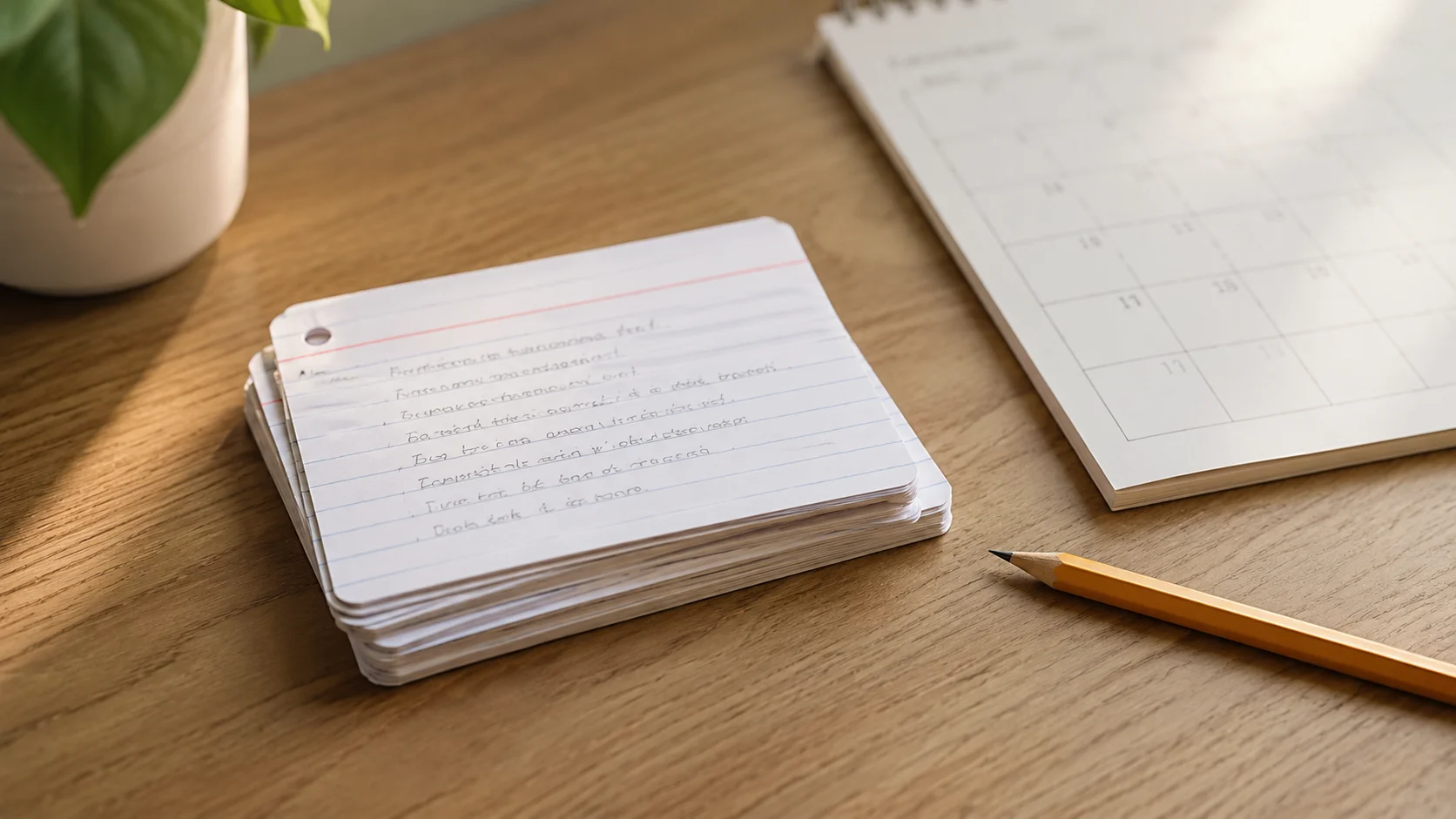
Spaced repetition is reviewing material several times with growing gaps between reviews, instead of studying it repeatedly in one sitting. The same total study time, spread across days, produces markedly better long-term memory than the same time massed together. It is one of the most reliably replicated findings in the psychology of learning.
The technique is old, cheap, and unglamorous — a list of dates and a stack of questions is enough to run it. It is also the single highest-leverage change most students can make, because it does not ask for more hours; it asks for the same hours placed differently.
Does spaced repetition actually work?
Yes, and the evidence base is unusually strong. A meta-analysis of 254 studies covering over 14,000 participants found a consistent advantage for distributed practice over massed practice: spacing reviews out produced better retention than cramming the same material into one block (Cepeda et al., 2006). A later review of the field's practical implications for education reached the same conclusion and called the effect one of the most robust in cognitive psychology (Kang, 2016).
Spacing also shows up in the two most-cited practical rankings of study techniques. Dunlosky and colleagues reviewed ten common learning strategies and rated distributed practice and practice testing as the only two with high utility across subjects, ages, and materials — while rereading and highlighting landed near the bottom (Dunlosky et al., 2013).
The short version: spacing changes how long memory lasts; testing changes how strongly it forms. Use both together and you have the core of an evidence-based study system.
Why does forgetting make spacing work?
Spacing works because retrieving something you have partly forgotten is what strengthens the memory. Hermann Ebbinghaus mapped this in 1885: without review, retention of new material drops steeply within the first day and keeps declining for a week. Each well-timed review flattens that curve — and the harder the retrieval feels, the more it helps.
This is why spacing feels worse than cramming while you do it. Massed rereading keeps the material fluent in working memory, which the brain misreads as "I know this." A review three days later, when recall is effortful, is doing real work. Robert Bjork's term for this is a desirable difficulty: the conditions that make study feel easy usually make learning weaker, and vice versa.
Retrieval itself matters enormously. In a study published in Science, students who practised recalling material learned far more than students who spent equal time re-studying it — with the retrieval group's advantage growing over the following week (Karpicke & Roediger, 2008). Spacing tells you when to review; retrieval practice tells you how.
How long should the gaps between reviews be?
Make the gap proportional to how long you need to remember the material. Cepeda and colleagues tested this directly and found the optimal gap scales with the retention interval: roughly speaking, a gap of about 10–20% of the time until your test produces the best results, and the longer you need to remember something, the longer the gaps should be (Cepeda et al., 2008).
| Exam is in… | Useful review gap | Practical schedule |
|---|---|---|
| 1 week | ~1 day | Day 1, 2, 4, 7 |
| 1 month | ~3–5 days | Day 1, 4, 9, 16, 30 |
| 3 months | ~1–2 weeks | Day 1, 7, 21, 45, 90 |
| A year (SEE / NEB cumulative) | ~1 month | Day 1, 7, 30, 90, 180 |
Do not over-engineer this. The difference between a good schedule and a perfect one is small; the difference between any schedule and no schedule is large. If you remember nothing else, use 1-3-7-14-30: review new material after 1 day, then 3, 7, 14, and 30 days.
What about the SM-2 and Anki intervals?
Flashcard apps automate exactly this decision. The classic SM-2 algorithm behind Anki and its descendants schedules each card individually: rate a card as easy and its next interval multiplies; rate it as hard and the interval shrinks or resets. You are not required to use an app — but if you have hundreds of facts to hold (vocabulary, formulae, definitions, dates), an algorithm beats a paper list because it tracks each item separately.
How do I use spaced repetition day to day?
Turn material into questions, answer them from memory, and schedule the ones you got wrong sooner than the ones you got right. That single sentence is the whole method. Everything below is logistics for making it survive contact with a real week.
- Convert, don't collect. After class, turn each page of notes into three or four questions. A note you never quiz yourself on is not study material; it is stationery.
- Answer before you check. Say or write the answer fully, then compare. Peeking early turns retrieval practice back into rereading.
- Sort into three piles. Got it easily → long gap. Got it with effort → medium gap. Missed it → tomorrow.
- Write the next review date on the card or page. A date on paper is a working scheduler.
- Keep sessions short. 15–25 minutes of review is enough; the schedule does the heavy lifting, not the session length.
- Interleave subjects. Mixing topics in one review session improves learning compared with drilling one topic at a time (Rohrer & Taylor, 2007).
Spaced repetition with no internet and one phone
The method needs no connectivity at all. Every mechanism — questions, dates, three piles — works on paper, and the phone-based versions work fully offline once material is downloaded.
- Paper cards with dates. Question on the front, answer and next-review date on the back. Cost: one packet of card paper.
- A notes app with a review-date heading. One note per week's questions; move items forward as you clear them.
- Voice-note quizzes. Record twenty questions with five-second pauses, then answer them aloud on the bus. Zero data.
- Offline flashcard apps. Sync once on Wi-Fi, review all week with data off.
- Downloaded material. When you have Wi-Fi, download notes, past papers, and class recordings; convert them into questions offline later.
Spaced repetition vs cramming: what is the real trade-off?
Cramming is not useless — it reliably produces a short burst of recognition that can carry you through a test tomorrow. What it cannot do is leave anything behind a week later, which is precisely the problem in a cumulative system like SEE or NEB where the same material returns in the final exam.
| Spaced repetition | Cramming (massed practice) | |
|---|---|---|
| Short-term test performance | Good | Good, sometimes better |
| Retention after a week or more | Substantially better (Cepeda et al., 2006) | Drops sharply |
| How it feels while studying | Harder, less fluent | Easier, falsely confident |
| Total hours needed | Same or fewer | Same, concentrated |
| Effect on sleep before the exam | None | Usually damages it |
A useful test of whether you have actually learned something: could you answer a question on it right now, with the book closed, three days after you last saw it? If not, the material is not learned yet — it was only recently read.
What are the common mistakes?
Nearly every failure of spaced repetition comes from one of five predictable errors, and all five are easy to correct once you can name them.
- Making cards you never review. A backlog of 800 unreviewed cards is a to-do list, not a memory system. Make fewer, review all of them.
- Cards that ask too much. "Explain the French Revolution" cannot be graded. Split it into single-fact questions.
- Reviewing without retrieving. Reading the front and the back together is rereading with extra steps.
- Memorizing before understanding. Spacing preserves memory; it does not create comprehension. Understand the concept first, then schedule it.
- Abandoning the schedule after a missed day. A late review is still a review. Restart the item, not the system.
How teachers can build spacing into a class
Teachers get spacing almost free by changing how each class starts. Three recall questions from the previous lesson, and one from last month, take four minutes and convert the whole class into distributed retrieval practice — a low-stakes version of exactly what the research recommends.
- Open every class with 3 quick questions: last class, last week, last month.
- Keep them ungraded. Low-stakes quizzing is about retrieval, not assessment.
- Set weekly cumulative homework instead of chapter-only homework.
- Re-test old topics in every unit test, not only the current unit.
- Publish a review calendar so students know what is coming back and when.
If your institution runs classes on a platform, this is easy to systematize: our AI tutor can turn a chapter into recall questions in seconds, and live classes make a four-minute opening quiz part of the routine rather than extra work.
Frequently Asked Questions
What is spaced repetition in simple terms?
It is reviewing material a few times with increasing gaps — for example after 1 day, then 3, 7, 14, and 30 days — instead of studying it many times in one sitting. The gaps force you to retrieve the information from memory, and that retrieval is what makes it stick.
How many times should I review something?
Four to five well-spaced reviews are enough for most exam material. What matters is that each review requires effort to recall; once an item comes back instantly and repeatedly, push its next review much further out and spend the time on weaker items.
Is spaced repetition better than active recall?
They are not competitors. Active recall is the action — testing yourself; spaced repetition is the timetable — when to do it. Both were rated high utility in the same review of learning techniques (Dunlosky et al., 2013), and they are designed to be used together.
Do I need an app like Anki?
No. Paper cards with review dates work. An app becomes worth it when you are managing hundreds of individual items — vocabulary, formulae, definitions — because it schedules each one separately instead of moving your whole stack together.
Can spaced repetition help with maths and problem-solving?
Yes, with an adjustment: space the problems, not the definitions. Return to a problem type after a few days and solve a fresh instance from scratch, and mix problem types within a session rather than drilling one kind, which improves learning (Rohrer & Taylor, 2007).
How far before an exam should I start?
As early as the material exists. Spacing needs calendar room to work — a month gives you five reviews, three days gives you one. If an exam is very close, spend the remaining time on retrieval practice rather than rereading; it is the best available option under time pressure.
Key Takeaways
- Spacing the same study time across days beats massing it — 254 studies agree (Cepeda et al., 2006).
- Effortful retrieval is the mechanism; if a review feels easy, it is doing little.
- Gap length should scale with how long you need to remember — start with 1-3-7-14-30.
- Retrieval practice plus spacing are the two highest-utility techniques in the research (Dunlosky et al., 2013).
- Cramming buys tomorrow's test and loses next month's exam.
- The whole method runs on paper and works offline — no app or internet required.
Further Reading
- Cepeda, N. J., et al. (2006). Distributed practice in verbal recall tasks: A review and quantitative synthesis. Psychological Bulletin. https://doi.org/10.1037/0033-2909.132.3.354
- Cepeda, N. J., et al. (2008). Spacing effects in learning: A temporal ridgeline of optimal retention. Psychological Science. https://doi.org/10.1111/j.1467-9280.2008.02209.x
- Karpicke, J. D., & Roediger, H. L. (2008). The critical importance of retrieval for learning. Science. https://doi.org/10.1126/science.1152408
- Kang, S. H. K. (2016). Spaced repetition promotes efficient and effective learning. Policy Insights from the Behavioral and Brain Sciences. https://doi.org/10.1177/2372732215624708
- Dunlosky, J., et al. (2013). Improving students' learning with effective learning techniques. Psychological Science in the Public Interest. https://doi.org/10.1177/1529100612453266
Related Articles
- How to study effectively in Nepal — the full study system this technique sits inside.
- SikshyaLab AI tutor — turn a chapter into recall questions in seconds.
- Live video classes — build a four-minute opening quiz into every class.
- SikshyaLab pricing — one flat monthly price for your whole institution.
Conclusion
Spaced repetition asks for a schedule, not more hours. Convert your notes into questions, answer them from memory, and come back after 1, 3, 7, 14, and 30 days — pulling weak items closer and pushing easy ones away. It will feel harder than rereading, and that feeling is the evidence it is working. Pick one subject and write tomorrow's review date on it before you close this page.
Milan Khati Chhetri
SikshyaLab Content Team